Three Sisters Springs and the Manatee Rules: Tickets, Sanctuaries and the Season
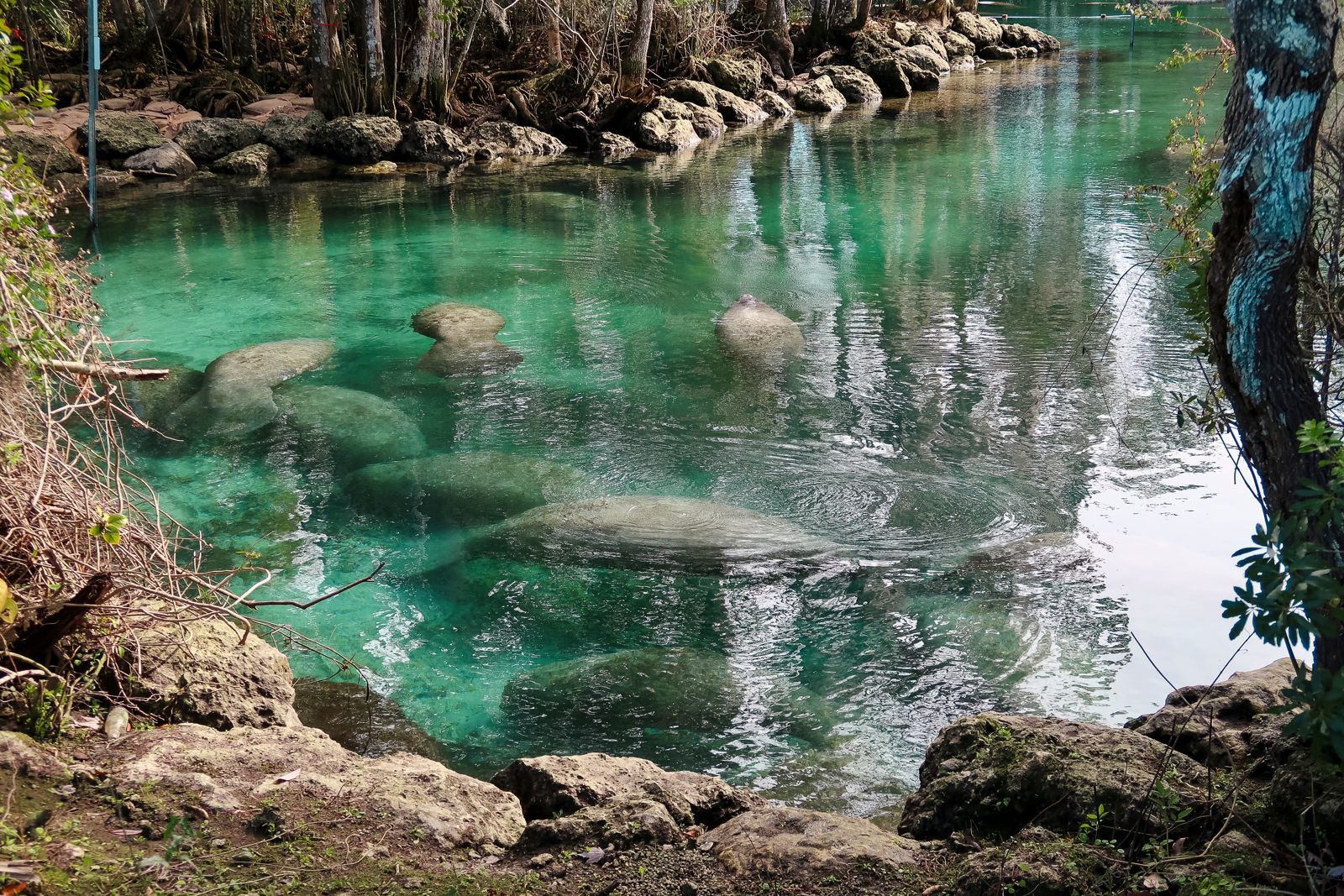
Three Sisters Springs is the most photographed place in Crystal River and the most regulated. There are two completely separate ways in. By land, you buy a ticket from the City of Crystal River’s Three Sisters Springs Center, ride the trolley and walk the boardwalk above the spring: no swimming, no water access at all. By water, you arrive by boat, kayak or paddleboard along the spring run from Kings Bay and may swim in, but only under federal rules that change with the season and sometimes with the day’s weather.
Those rules are the heart of any visit here. From November 15 to March 31 the seven federal manatee sanctuaries in Kings Bay are closed to every water activity, paddle craft are banned inside Three Sisters Springs, and the U.S. Fish and Wildlife Service can close more water at short notice when manatees crowd in. All year, a short list of things you must never do to a manatee applies across the whole bay. This guide sets out who runs what, how the boardwalk works, what is open on the water and when, and the rules behind it, so that none of it comes as a surprise at the dock.
Who runs Three Sisters Springs
The ownership is unusual, and it explains why there are two sets of rules.
- The Crystal River National Wildlife Refuge, run by the U.S. Fish and Wildlife Service, was established in 1983 and is the only refuge created specifically to protect the Florida manatee. It preserves Three Sisters Springs as the last unspoiled and undeveloped spring habitat in Kings Bay.
- The land is jointly owned by the City of Crystal River and the Southwest Florida Water Management District. The Service manages it as part of the refuge under a lease with the City.
- Land access (the boardwalk, the trolley, the tickets) is managed by the City’s Three Sisters Springs Center. The property opened to the public in November 2014.
- The water is covered by federal rules: the Kings Bay Manatee Refuge, designated in 2012 over the whole bay, and the seven manatee sanctuaries inside it.
In short: the City sells you the walk; the Service decides where you may swim.
The boardwalk: what a land visit includes
The Three Sisters Springs property covers 57 acres, with more than 2 miles of trails as well as the boardwalk around the springs. In the winter months the boardwalk is the most popular place in Crystal River to watch manatees from above the water.
How a visit works:
- Start at the Three Sisters Springs Center, 917 Three Sisters Springs Trail. Access is by trolley, on foot or by bicycle. Park in the center’s signed spots or the overflow lot behind it, not in the plaza, where cars may be towed.
- Walking or cycling in? The front gate at 601 Three Sisters Springs Trail also sells tickets (cards only) and handles walk-in and bicycle access, but has no public parking beyond a few ADA spaces.
- The trolley is included with daily admission. There is no public parking at the springs themselves unless you hold a disabled parking permit.
- Both the trolley and the boardwalk are wheelchair accessible. Citrus County’s visitor bureau describes the boardwalk as fully accessible.
- Trails are easy, with no elevation gain; they are gravel or grass apart from the boardwalk.
- Restrooms and water-bottle filling stations are on site for land visitors.
What a land ticket does not include:
- Any water access. There is no swimming from the boardwalk or from the land around the springs; the City keeps people out of the water there to protect the banks from erosion.
- A swim with manatees. The City says plainly that the boardwalk visit is not a swim tour, and that it does not rent kayaks or paddleboards; both are run by private guides and outfitters in town.
Boardwalk tickets, prices and hours
Tickets are sold by the City’s Three Sisters Springs Center, online or on site, and the price depends on the season. The City’s summer admission runs April 1 to November 14 and its winter admission November 15 to March 31. On the City’s current price list:
| Ticket | Summer | Winter |
|---|---|---|
| Adult | $12.50 | $20 |
| Senior (55+) | $12.50 | $17.50 |
| Military | $11.50 | $15 |
| Child (6 to 15) | $7.50 | $7.50 |
| Child (5 and under) | Free | Free |
What the ticket covers and how the day works:
- The shuttle is included. One-day admission includes the trolley to and from the springs, and you wear a wristband to ride it.
- Shuttle hours: it leaves the Three Sisters Springs Center continuously from 8:30 a.m. to 4:30 p.m.
- Last tickets: the last admission ticket is sold at 3:30 p.m., so do not leave it to the end of the afternoon.
- Other stops: the shuttle also calls at the refuge visitor center, the NW 3rd parking lot (a 2-minute walk from Hunter Springs Park), Town Square and Heritage Village, which makes it a handy link between the boardwalk and a swim launched from town.
- No refunds: all ticket sales are final, with no returns, exchanges or cancellations. Buy for the day you are sure of.
The trails themselves are open 8:30 a.m. to 4:30 p.m. all year, except on Good Friday, Memorial Day, Independence Day, Labor Day, Veterans Day, Thanksgiving and Christmas. All prices are subject to change, so check the City’s ticket page before you go.
Discounts worth knowing:
- Federal recreation passes and Duck Stamps: an adult pays $15 in winter and $7.50 in summer, and the discount covers the pass holder plus 3 guests.
- Annual pass: $100 for walk-in or bicycle-in access, or $140 with the trolley, for the holder and up to three guests a day for 365 days. Federal pass holders get $20 off.
FWC notes that boardwalk viewing at Three Sisters runs on a limited schedule, so check the day’s opening before you plan around it. It is a day-use site only, with no camping.
Boardwalk rules
- Only service animals are allowed. Leave pets at home.
- No selfie sticks or other camera extension poles, and no drones. Flying drones on any national wildlife refuge is prohibited.
- Stay on the trails and boardwalk. Three Sisters Springs is a wetland, and alligators and venomous snakes live in it.
- Guided walks: in manatee season, Fish and Wildlife Service volunteers lead guided walks; ask the volunteers at the boardwalk for times. The refuge runs ranger-led programs at Three Sisters Springs daily from November 15 to March 31, and less often the rest of the year.
- Birders: more than 100 bird species have been documented on the property.
Three Sisters Springs by water
The water side is where the rules bite. You can only reach the spring run by paddle craft or boat, and motorboats are not allowed inside the springs, so boats tie off outside and people swim or paddle in.
| April 1 to November 14 | November 15 to March 31 | |
|---|---|---|
| Kayaks and paddleboards inside the springs | Allowed | Not allowed |
| Motorboats inside the springs | Not allowed | Not allowed |
| Swimming and snorkeling | Allowed, unless a temporary cold-front closure is in place | Allowed in daylight when not closed; often closed entirely on the coldest days |
| Scuba diving and fishing | Scuba allowed; fishing has no seasonal ban | Not allowed |
| Any water activity between sunset and sunrise | No seasonal ban | Not allowed |
Three Sisters Springs has three main spring vents and many smaller ones, joined to the canal by a spring run. A canal was dug in the 1960s to let boats in, and in 1982 pilings were placed at the entrance to limit boat traffic, which is why boats stop outside and visitors go in under their own power.
In manatee season, whether you get in at all depends on the day. The City says the Service can close in-water access to Three Sisters Springs when the Gulf drops below 62.2°F, and temporary closures are posted on the refuge’s Facebook page. When it is open, in-water access runs from sunrise to sunset. One local outfitter explains the pattern: on some days you can tie off outside Three Sisters Springs and swim in; when it is too cold, the manatees must come in to survive and the springs are blocked off for all activities. The federal rule allows the Service to extend a no-entry area up to 400 feet from the Three Sisters Springs Sanctuary, including north into the springs themselves.
Getting to the spring run by water
If you are paddling yourself, you start from the bay, not from the boardwalk. The refuge has no water-access facilities of its own, but it lists two public kayak launches on Kings Bay: Hunter Springs Park at 104 NE 1st Ave and King’s Bay Park at 268 NW 3rd St. Several city boat ramps and fee-charging private ramps also give access, and outfitters on the water launch rentals from their own docks; one puts the paddle from its dock to Three Sisters Springs at 25 to 35 minutes.
The spring run joins a canal on the east side of the bay, and the sanctuary at its mouth is one of the seven. In season, follow the markers: the line is the edge of the sanctuary, and crossing it in a kayak is exactly what the rule forbids.
The seven sanctuaries of Kings Bay
The federal manatee sanctuaries are the core of the winter protection. From November 15 to March 31 every year, all waterborne activities are prohibited inside them: no swimming, no snorkeling, no paddling, no boats. In Kings Bay they are:
- Banana Island Sanctuary
- Sunset Shores Sanctuary
- Magnolia Springs Manatee Sanctuary
- Buzzard Island Manatee Sanctuary
- Tarpon Springs Manatee Sanctuary
- Warden Key Manatee Sanctuary
- Three Sisters Spring Sanctuary
The refuge staff set up, monitor and enforce them. On the water, Citrus County’s visitor bureau describes them as sanctuary markers near the spring vents that designate critical resting areas, and swimmers, kayakers and all watercraft are kept out. If you are on a guided tour, the captain knows where the lines are; if you are paddling yourself, the markers are the line.
Temporary no-entry areas
Beyond the fixed sanctuaries, the Service can add no-entry areas when they are needed, and they take effect immediately. In a no-entry area every water activity is prohibited, swimming and snorkeling included.
From November 15 to March 31, the trigger is manatees overflowing a sanctuary, or shifting into Three Sisters Springs, House Spring, Jurassic Spring or Idiot’s Delight Number 2 Spring. The decision is based on aerial counts, current weather and other information, and the limits are:
- Around the other Kings Bay sanctuaries: up to 100 feet beyond the sanctuary boundary.
- Around the Three Sisters Springs Sanctuary: up to 400 feet, including into the springs.
- Around House Spring and Jurassic Spring: up to 100 feet from the spring vents.
From April 1 to November 14, temporary no-entry areas can still be set during cold fronts when manatees are present, for no more than 14 days in a row.
No-entry areas are marked by buoys, float lines and signs, or by Service staff on site. In practice this is why no operator can promise a particular spring on a particular day.
Manatee Manners: what you must never do
The U.S. Fish and Wildlife Service encourages passive observation: not starting contact with manatees, and watching calmly from a distance, at the surface. The refuge asks everyone to watch its Manatee Manners videos before any activity in Kings Bay.
These activities are prohibited in all waters of Kings Bay, Three Sisters Springs included, all year:
- Chasing or pursuing a manatee.
- Disturbing or touching a resting or feeding manatee.
- Diving from the surface onto a resting or feeding manatee.
- Cornering or surrounding a manatee.
- Riding, holding, grabbing, pinching, poking, prodding or stabbing a manatee with anything, hands and feet included.
- Standing on a manatee.
- Separating a mother and calf, or a manatee from its group.
- Giving a manatee anything to eat or drink.
- Starting contact with a belted or tagged manatee.
- Interfering with rescue or research work.
Under the federal rule, a resting manatee is a mostly motionless one that rises to breathe from the bottom, the water column or the surface, and the prohibitions cover you in the water, in a boat and on shore.
What passive observation means in the water
The rules translate into a few habits that good guides teach before you get in:
- Float, don’t swim at them. One outfitter explains that the wetsuit keeps you buoyant so you stay out of the manatees’ space, and does not allow fins on its swim tours; most of the water is under 6 feet deep, so you do not need them.
- Stay at the surface. Diving down onto a resting manatee is exactly what the rule forbids.
- Let the manatee choose. If one approaches, keep still. Reaching out to touch it is the most common way swimmers break the rules.
- Give mothers and calves room, and never get between them.
- Watch the breathing. FWC says a resting manatee can stay down up to 20 minutes, and an active one surfaces every three to five minutes. A manatee rising to breathe needs a clear path.
Boat speed in Kings Bay
The whole of Kings Bay is a slow-speed zone all year. The single exception is a posted area north of Buzzard Island, where boats may travel up to 25 miles per hour in daylight from June 1 to August 15. Inside sanctuaries and no-entry areas you may not be at all. If you rent a motorboat, ask the outfitter for the current speed-zone map.
When the season is best
The season is fixed by the calendar: November 15 to March 31. Inside it, the City’s advice for seeing manatees in Three Sisters Springs is simple: come on a cold winter day, when the Gulf is below 68°F, and look for cold fronts and high tides. Manatees move in and out of the springs as temperatures and tides change, so a mild afternoon can be quiet even in January.
That creates a trade-off you should plan for. The boardwalk, by contrast, is open every day and is not affected by the Service’s in-water rules. The coldest days bring the most manatees to the springs, and they are also the days when Three Sisters Springs is most likely to be closed to swimmers. On those days the boardwalk often gives the best view of all, and the swim tours work the open water elsewhere in Kings Bay.
Outside the season, the sanctuaries reopen and paddle craft are allowed back inside Three Sisters Springs from April 1. FWC notes that in warm weather manatees spread out along the coast, so sightings take more travel and luck.
The refuge visitor center
The refuge’s own visitor center and nature store, at 1502 SE Kings Bay Drive, is free and a good first stop for maps and the current situation. It opens 9 a.m. to 4 p.m. daily from November 15 to March 31, and 10 a.m. to 4 p.m., Monday to Friday, from April 1 to November 14.
If you find a manatee in trouble
Report any injured, sick, dead, tagged, orphaned or distressed manatee to FWC’s wildlife emergency hotline, 1-888-404-3922. The refuge asks for the location, the time, the approximate size, the nearest public boat ramp and, if you can, photos or video for the biologist who calls you back. Assisting injured and orphaned manatees is part of the refuge staff’s work all year.
Frequently asked questions
Can you swim in Three Sisters Springs?
Yes, but only by arriving through the water, and only when it is not closed. There is no water access from the boardwalk or the land. From November 15 to March 31 paddle craft must stay outside, swimming is not allowed between sunset and sunrise, and on the coldest days the springs can be closed to everyone.
When are the manatee sanctuaries closed?
From November 15 to March 31 every year. All waterborne activities are prohibited inside the seven Kings Bay sanctuaries during that period, and temporary no-entry areas can be added around them.
Can you kayak into Three Sisters Springs?
Only from April 1 to November 14. From November 15 to March 31 paddle craft are not permitted inside the springs. Our guide to swimming with manatees compares kayak and swim tours.
Can you touch a manatee in Crystal River?
No. Touching a resting or feeding manatee, chasing, cornering or feeding one are all prohibited in Kings Bay. The U.S. Fish and Wildlife Service encourages passive observation from the surface.
Is the Three Sisters Springs boardwalk a manatee tour?
No. It is a walk on land, run by the City, with no water access. Swims and boat tours are run by private operators; see our tours page and our Orlando and Tampa guide for where they start.