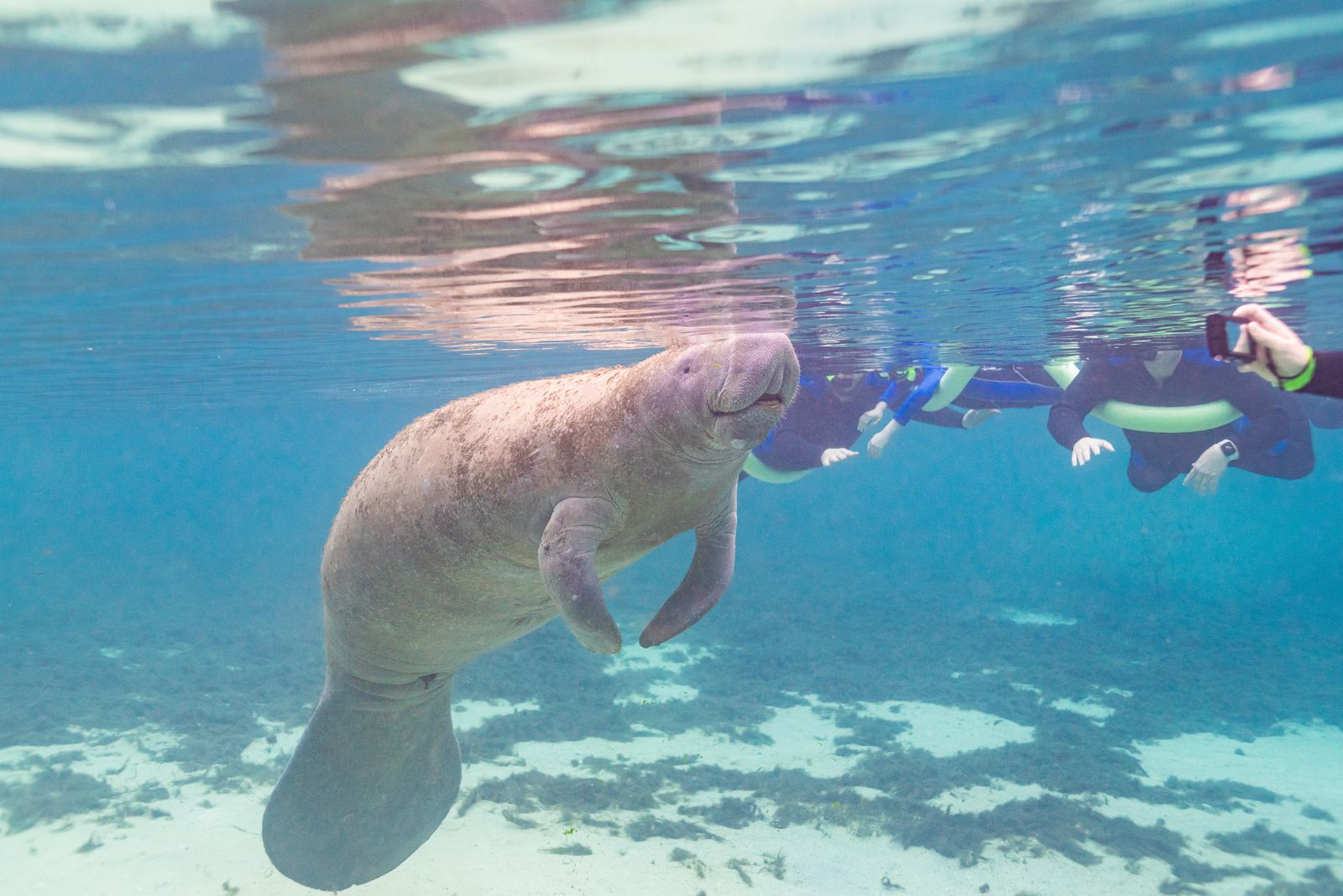
Swim with Manatees in Crystal River: Snorkel Tours, Boat Tours and Kayaks Compared
Crystal River is one of very few places where you are allowed to get into the water with wild manatees, and Kings Bay is where it happens. Each winter the refuge counts more than 600 manatees migrating into the bay’s warm springs, and a fleet of small permitted boats takes swimmers out to them in wetsuits and snorkels. The refuge itself runs no tours: every manatee tour on Kings Bay is run by a private business under a Special Use Permit from the Crystal River National Wildlife Refuge.
The choice is less about which company and more about which format. There are four: a group snorkel tour on a pontoon boat, a private or semi-private boat, a stay-dry viewing cruise, and paddling yourself by kayak or paddleboard, guided or not. They differ in price, in how close you get, and in what the rules let you do in each season. This guide compares them, with one operator’s own published prices as a yardstick, and explains what actually happens in the water.
How a manatee swim works
The basic format is the same on most tours:
- Check-in at the operator’s shop or dock in town. Everyone on the boat must be booked, swimmers and ride-alongs alike, because each boat is licensed for a fixed number of passengers.
- A short briefing. Swimmers on manatee tours learn Manatee Manners before getting in the water, and the refuge asks every visitor to watch its videos.
- Wetsuit, mask and snorkel. Most tours include them. The wetsuit is about more than warmth: it keeps you buoyant, so you float at the surface instead of kicking toward the animals.
- A boat ride to where the manatees are that day. Captains choose the spot by the weather, the tide and which areas are open. Nobody can guarantee a sighting: it is a wild animal.
- In the water with a guide. You float at the surface and watch. You do not chase, touch or dive down onto a manatee; those are federal rules, not tour etiquette.
- Back to the dock, with photos often offered for sale.
On one Kings Bay operator’s own listing, the group snorkel tour takes 3 hours for up to 12 passengers, all ages welcome, with an in-water guide and photographer included. A rental outfitter that also runs tours lists its swim tours at about 2 to 2.5 hours. The time is mostly the boat ride, the briefing and getting into wetsuits; the time actually in the water depends on the day.
What it costs: one operator’s prices
Prices vary by operator, by season and by group size, so treat this as a yardstick, not a quote. On one Kings Bay operator’s own site in October 2026:
| Option | Price |
|---|---|
| Group snorkel tour, adult (wetsuit, mask and snorkel included) | $80 |
| Active military and veterans | $72 |
| Children 6 and under (wetsuit included) | $68 |
| Non-swimmer riding along | $65 |
| Private snorkel tour, from | $750 |
| Sightseeing pontoon tour, 90 minutes, from | $55 |
Two things stand out. The ride-along price is not much lower than a swim, so if someone in your party will not get in, the cheaper choice may be a viewing cruise for the whole group. And the private boat is priced per boat, not per person, which makes it competitive for a family or a group of friends who fill it.
Our tours page lists the swims we found, with what each includes, how long it takes and how big the group is.
Format 1: the group snorkel tour
This is the classic Crystal River trip and the one most people book.
- Who it suits: anyone who wants to be in the water with manatees, including children; the operator above welcomes all ages.
- Group size: up to 12 on the pontoon boats of that operator.
- What to check: whether the wetsuit is included, whether an in-water guide comes in with you, and whether photos are included or sold afterward.
- The trade-off: you share the boat and the water with strangers, and the captain picks the spot for the group.
A heated boat is worth looking for in midwinter. The days that bring the most manatees into the springs are, by definition, the coldest ones, and you will spend the ride back wet.
The group swims on our tours page show the range. One small-group swim includes a scenic boat ride, an in-water guide and photographer, the mask, snorkel and wetsuit, and free parking, and welcomes children 3 and up. Another opens with a classroom presentation and an introductory video in five languages, includes hot cocoa, and sells its photo package separately. A third, a small-group VIP tour, uses a covered pontoon that is heated in winter, with the captain in the water as guide and photographer. All three are listed at 3 hours.
Format 2: private and semi-private boats
A private boat gives you the whole tour for your own group, and a semi-private one caps the numbers below a standard group tour.
- Who it suits: families with small children, nervous swimmers, photographers, and groups who would rather not share.
- Price: on the operator above, the private snorkel tour starts at $750 for 4 hours. Split across a full boat, that can be close to the per-person group price.
- The advantage: the captain can go at your pace and answer your questions; you are not waiting on anyone else to get suited up.
- Semi-private as a middle way: the semi-private swim on our tours page runs about 3 hours on fully enclosed boats that are heated on cooler days, with snorkeling gear included. Ask how many guests share the boat before you book.
- What does not change: the rules. A private boat cannot take you into a sanctuary or a no-entry area, and it cannot promise Three Sisters Springs.
Format 3: the stay-dry viewing cruise
Not everyone wants to get into the water in January, and the manatees do not mind.
- Who it suits: non-swimmers, very young children, anyone with mobility limits, and anyone visiting on a cold day without a taste for wetsuits.
- What you get: a boat tour of Kings Bay looking for manatees from above the water. On the operator above, a shaded pontoon sightseeing tour lasts 90 minutes and starts at $55.
- On our tours page: a 1.5-hour viewing cruise on a Coast Guard-certified boat, searching Kings Bay for wild manatees, with birds, turtles and the occasional dolphin. You meet at the operator’s shop and are shuttled to the marina.
- The trade-off: you see backs and snouts rather than the whole animal underwater. The manatee’s snout is often all that breaks the surface when it breathes.
If your group is split between swimmers and non-swimmers, compare a swim tour plus ride-along places with a viewing cruise for everyone; the second can be the better day.
Format 4: kayaks, paddleboards and clear kayaks
Paddling puts you on the water at your own pace, and in summer it is the way into Three Sisters Springs itself.
- Guided clear-kayak tours let you look down through the hull at the springs and anything swimming below. The 2-hour clear-kayak tour on our tours page takes up to 10 and changes route with the season: from November 15 to March 31 Three Sisters Springs is closed to paddlers, so it watches manatees in the warm springs of Kings Bay, with no swimming; from April 1 to November 14 it paddles into the springs, with time to swim. One outfitter also runs a night tour of about 2.5 hours.
- Self-guided rentals are cheaper and freer. Public kayak launches on Kings Bay include Hunter Springs Park (104 NE 1st Ave) and King’s Bay Park (268 NW 3rd St), and outfitters on the water launch from their own docks. One puts the paddle to Three Sisters Springs at 25 to 35 minutes.
The season decides where you can paddle:
- From April 1 to November 14, kayaks and paddleboards are allowed inside Three Sisters Springs.
- From November 15 to March 31, paddle craft are not allowed inside the springs, and the seven sanctuaries are closed to all water activities. You can still paddle the open bay, and on some days tie off outside Three Sisters Springs and swim in.
If you want to swim from your own kayak in season, outfitters set conditions. One requires a $30 swim package (wetsuit, mask, snorkel, dive flag, anchor and swim noodle) and two U.S. Fish and Wildlife videos before you launch. To paddle your own rental you must be 12 or older, with an adult 18 or over renting.
Comparing the formats
| Group snorkel | Private or semi-private | Viewing cruise | Kayak or paddleboard | |
|---|---|---|---|---|
| In the water with manatees | Yes | Yes | No | Possible, in open areas |
| Typical length on the operators quoted | 3 hours | 4 hours (private) | 90 minutes | About 2 hours guided |
| Gear included | Usually | Usually | Not needed | Kayak; swim gear extra |
| Best for | Most visitors | Families, groups | Non-swimmers, cold days | Summer, active visitors |
| Into Three Sisters Springs in season | Only when open to swimmers | Only when open to swimmers | No | No paddle craft inside |
Choosing an operator
Kings Bay has many permitted operators, and from the outside their listings look alike. The refuge publishes a list of its permitted tour operators, with the rentals and guided tours each offers, so the first check is simply whether a company is on it. After that, these are the questions that separate one tour from another:
- How many people share the boat? A group tour on the operator above carries up to 12; a semi-private tour carries fewer; a private tour carries only you.
- Does a guide get in the water with you? An in-water guide keeps the group calm and in the right place, and on the operator above one is included.
- Is the boat heated or covered? In midwinter this matters more than almost anything else on the list.
- Are photos included or sold afterward? Some tours bring a photographer and sell the pictures at the end.
- What happens if the weather turns or the springs close? Ask about rescheduling and refunds before you pay; terms differ between operators and between booking sites.
- Is there a non-swimmer price? If not everyone is getting in, a ride-along place or a viewing cruise may suit the group better.
None of these are about the manatees themselves. Every permitted operator works under the same federal rules, and none can promise a sighting; what you are choosing is the boat, the group and the people looking after you.
Where the boats go, and why it changes
Kings Bay is a 600-acre bay with more than 70 springs, most of them in the eastern half: Hunter, Tarpon Hole and Three Sisters are the names you will hear. In winter the manatees crowd into the warm water around the springs, and the federal rules decide where you may follow.
- The sanctuaries are off limits from November 15 to March 31: no swimmers, no kayaks, no boats.
- Three Sisters Springs closes to all water activity from sunset to sunrise in season, and the Service can close it entirely, out to 400 feet from the sanctuary, when manatees pack in.
- Temporary no-entry areas can appear around other springs and sanctuaries at short notice, decided from aerial counts and the weather.
This is why tour listings say “Kings Bay” rather than promising a spring. A good captain works around the closures to find manatees in open water.
In the water: the rules every tour follows
The U.S. Fish and Wildlife Service encourages passive observation: no starting contact, and watching calmly from a distance at the surface. In all waters of Kings Bay, all year, it is prohibited to:
- Chase or pursue a manatee, or corner or surround one.
- Touch or disturb a resting or feeding manatee, or dive onto one from the surface.
- Ride, hold, grab, poke or prod a manatee, or stand on one.
- Separate a mother and calf, or a manatee from its group.
- Feed a manatee or give it anything to drink.
- Start contact with a belted or tagged manatee.
In practice, the guides will tell you to keep your hands to yourself and your feet up. One outfitter does not allow fins on its swim tours at all: most of the water is under 6 feet deep, and fins stir up the bottom and spoil the visibility.
What you will see
The Florida manatee is a large gray aquatic mammal, listed as threatened under federal law. FWC puts a typical adult at 9 to 10 feet long and around 1,000 pounds. When resting a manatee can hold its breath for up to 20 minutes; when active it surfaces every three to five minutes. So in the springs you will often see animals lying still on the bottom or hanging in the water, rising slowly to breathe.
How many you see depends on the cold. The refuge counts more than 600 in Kings Bay each winter; Citrus County’s visitor bureau says between 500 and 1,000, and one outfitter says up to 800 gather on the coldest days. Out of season the numbers fall: the bureau says up to 100 stay all year, and the same outfitter counts roughly 30 to 50 residents on a given day.
When to book
- The season: November 15 to March 31 is when the manatees gather and the tours are fullest.
- The best days: the City’s advice for Three Sisters Springs is a cold winter day, when the Gulf is below 68°F, ideally during a cold front and a high tide.
- The catch: those same coldest days are when the springs are most likely to be closed to swimmers, and when a heated boat matters most.
- The rest of the year: tours run all year, and you will usually still find manatees, but in smaller numbers and more spread out.
Book ahead for weekends and holidays in season. Cancellation terms vary by operator and by where you book; check them before you pay.
What to bring
- A swimsuit to wear under the wetsuit, and dry clothes and a towel for afterward.
- Sunscreen, a hat and polarized sunglasses for the boat, as one outfitter recommends.
- Cash or a card if you want the photo package, which is usually sold at the end.
- Patience. The best encounters come when you float still and let the manatee decide.
Frequently asked questions
How much does it cost to swim with manatees in Crystal River?
On one Kings Bay operator’s own price list in October 2026, a 3-hour group snorkel tour costs $80 for an adult with the wetsuit included, $68 for children 6 and under and $65 for a non-swimmer riding along. Private boats start at $750. Compare current prices on our tours page.
Is swimming with manatees allowed?
Yes, in Kings Bay, under federal rules. Tours operate under Special Use Permits from the refuge, and the U.S. Fish and Wildlife Service requires passive observation: no touching, chasing or feeding.
Do I need to be a strong swimmer?
No. You float at the surface in a buoyant wetsuit, fins are often not used, and one outfitter says most of the water is under 6 feet deep. Non-swimmers can ride along or take a viewing cruise instead.
Will I definitely see manatees?
No operator can guarantee it. Your chances are best from November 15 to March 31, especially on cold days, when hundreds of manatees gather in Kings Bay.
Can I swim at Three Sisters Springs?
Only by arriving through the water, and only when it is open. Our Three Sisters Springs and manatee rules guide explains the closures, and the Orlando and Tampa guide covers getting here.